Page 2 of 3

All aboard…

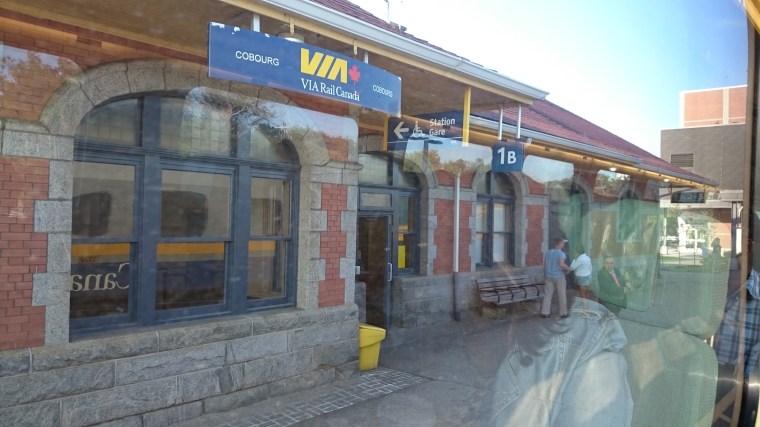
On the via rail train heading east of Kingston. On the way to Montreal. Blow at High Dough from the Hip is going through my mind. It’s less than a week since Gord Downie and his fellow tragically hipsters played the final show here on their farewell tour.

I like the way those guys think. Downie gets diagnosed with inoperative brain cancer and they go blow it out on the road one last time. To hell with you cancer, I’ll go out on my terms, he seems to be shouting to that bitch of a disease. Who knows, maybe he’s got more music in him still.

This is my first Canadian train trip. After all of these years.

image
Toronto from VIA Rail tracks.


I’ve done a bit of the train thing in Europe. Done plenty of city trains throughout Canada and the US. And I’ve even taken a few old fashioned trains at theme parks like Fort Edmonton and Heritage Park in Calgary. But this is my first Via Rail in Canada. I’m sorry I waited this long.

On board with my bride and first born, this is a pretty cool perspective of a part of the world I’ve only seen from the air. There’s a touch of elegance to rolling this way, even back here in economy.

Patricia and I are in the early days of a couple of weeks in Toronto and Montreal. Montreal is where we’re heading now. We flew in Monday night and crashed at daughter Kristina’s place near Queen and University. A brisk predawn walk to the subway taking us to Union Station woke us up after dinner last night with our friend Richard. He just hit the same unmentionable birthday that I recently did, so we celebrated at Biff’s Bistro, a great French spot that I haven’t been to since my pharma days on Front and Yonge.

image

It’s been over a year since my last visit to Montreal. And this will be the first time there with my gals (two out of three, anyway). Really looking forward to that. I’ll also get to meet their friend (and Richard’s) Francois. He’s generously opened his doors to us. It’s great to live as a local when travelling.

This will be fantastic brain food.

If you’ve been to Montreal, you’ll know that it is North America’s best taste of Continental Europe. You’ll also know that the people there are as friendly as they come. I’ve found that to be true even with my poor French. When I say poor, I should say basically non existent. A combination of bad public school French when I was a young lad and the fact that all of my French speaking friends having excellent English which they like to practice. I also lay blame on my lack of French skills on the beautiful French teacher I had in grade 7. She agreed to pass me — just — if I promised not to take her class again. I was devastated. And the reason I struggled in her class was mostly because her presence scrambled my mind, I just couldn’t concentrate on French or anything else when she was in the room. C’est la vie.

image

It’s quite spectacular to watch the country side role by at train speed. You can take things in, even at train speed. And the way you intersect the smaller communities as you role in comes with a sense of nostalgia. And it’s lovely to hear the train whistle blow from inside our care. More nostalgia, I suppose.

We’re now stopping in Cornwall, ON. That’s enough blogging for now. I’ll dial in again from Montreal. Au revoir.

-30-

P.S. Check out my daughter’s latest blog post at httpwestmeetseast.wordpress.com

Classic rock, a few beers and Fat Man

Years before I started making a few shekels as an ink stained wretch, writing paid off for me.

Starting in Grade 5 I figured out that my language arts and English teacher’s dug what I put to pen. It got me through all the way to graduation and balanced off my failings in math.

Almost.

DSC_0750
This has nothing to do with the blog. But i thought it was pretty cool. Clouds in downtown Edmonton shot from the 18th floor of Commerce Place.

Short stories, essays, reviews – I seemed to always hit the mark. I was also able to write my way through social studies. It was just a shame about math. And the sciences.

Anyway, I always took the writing thing for granted until…well, regular readers of this blog know all about my putting off the book writing thing until a stroke buzzed my brain’s ability to read and write, the struggle to relearn my abcs and all that jazz.

I’ve pumped out some good stuff since getting my writing groove back. But I’ve also struggled. When I was a news paper reporter I pounded out the stories of the day. In writing a feature on my stroke recovery, it was pretty easy to connect the dots. But I’ve done some flailing away on the edits to the book I’ve been working on about my stroke. And I’ve struggled with keeping my focus on the blog.

There’s just been something. Something wrong. I haven’t been able to put my finger on it.

Then my bride asked me if I’d like to go to the K97 classic rock show Friday night in Edmonton’s Hawrelak Park. I try not to live in the past, but David Wilcox was playing. Non Canadian readers may not know this blast from my past’s work. If not, you should look him up and give him a spin.

Back in the 80s I quit a job to go see him play at a Southern Alberta Institute of Technology (I think they now call my Calgary alma mater SAIT Polytechnic) cabaret. When I asked for the night off to see David play, my boss asked me what was more important, the concert or my part time job doing grunt work at his crappy little motel.

“Thank’s for the clarity, boss,” I like to remember myself saying to him. “I’ve unplugged my last toilet for one of your guests.”

David WilcoxAug2016Edmonton
David Wilcox

It was off to hook up with Joe, Jack and Brad, then off to see David and his band play.

Later, when I was entertainment editor of the campus newspaper I got to interview Wilcox before a show. Just me and him. No rush.

I asked him a question he told me nobody had ever asked him before. That was cool. As I recall, I asked about the way his eyes seem to bug out as he plays a solo. Also as I recall, he speculated that it may be because when he started out and he’d get into a riff, he stair off into the crowd, lost in his guitar. The thing is, the beautiful young woman dancing with her insecure and bulky boyfriend would think David was gazing into her eyes. And the trouble would begin with beefy boy and David. So, as a peace loving man, Mr. Wilcox said he just stated staring safely into the sky when he made his Telecaster sing. And that, he said, may be the cause of the eye thing.

That’s how I remember the convo, anyway.

Friday night David’s show was just as tight as it was back in the mid 80s. And he looked to be having just as much fun. It was awesome. Wilcox was followed on stage by Randy Backman of Guess Who and Bachman-Turner Overdrive fame.

He put on one hell of a show.

I don’t have the emotional connection to Backman that I do with Wilcox, but I was blown away by how great he sounded. And by how much fantastic music he’s pumped out. But better still, the passion he had in playing and in telling the stories behind the songs blew me away.

Backman shared intimate details of where he was when he wrote one classic. He explained nuances in the music and the work to get the stuff from his brain to his guitar to the radio. 

What a great night.

But it wasn’t until the Saturday night over a few beers at a bbq my wife and I through for the neighbors that I connected a few dots.

According to Google – and is Google ever wrong? – Randy Backman is 72 year old. Another Google search put David Wilcox at 67. Backman is a gazillionare world wide selling artist and will likely make more in royalties in the time you take to read this blog than I’ll ever make. Wilcox is a journeyman musician doing just fine but on a smaller scale.

And there they both were, on stage looking in love with what they were doing after all of these years. I’m sure there are lots of reasons. But a couple came to my mind over beers in my back yard 24 hours after the show, my ears still ringing from what poured out of their Marshall amps.

These guys has the courage, the passion the whatever to do what they were meant to do. No matter what. It worked out on different levels. But it worked out. They didn’t do this music thing half assed. They did it full assed.

And that’s where Fat Man comes in.

Back in grade 5 I thought I was a pretty good story teller. And for a class early in the year I started working on a short story. My first effort was some kind of gumshoe crime fighter. Then I took a stab at a cowboy bit. Both were boring and un inspiring.

It was then that a sketch I did for art class caught my eye. I’d created and un-hero called Fat Man. He looked kinda funny in a loveablish way. I decided to call my short story The Adventures of Fat Man and I managed to put together a yarn that had all of the teachers at Chris Ackerman Elementary School in North East Calgary laughing.

The trick, I realized back then, wasn’t a trick at all. Being a writer is one thing. But to be a good or even great story teller means being true to who you are and telling those stories in the way they need to be told. Don’t try to be a great classical violinist if you’re a blue grass fiddler.

I’d like to be a jazz bassist. But I may be a punk rock guitar player. Gotta live with that and make it work.

Oh, by the way, my first born has a new blog. It’s westmeetseast.wordpress.com. The kid has game.

Oh again…if you have an Amazon Kindle, you may want to take a look at my short story, The Gunman Who forgot Who to shoot.

-30-

Tick tock, tick tock – can’t stop the clock

Some things grab you by the throat and just won’t let go.

You fight for every trickle of breath you can coax in and you punch, scratch and kick with every scrap of fight remaining to loosen the grip of the thing, swearing that if you ever break free you’ll never ever get within a mile of its grip again.

2015-07-27 14.55.18

It’s been a year since my oldest and I drove from Edmonton, AB, to Toronto, ON where she’s now living. This shot is in Colonsay, SK. Time keeps ticking.

Sometimes the thing is a monster – like the bitch of a stroke that wreaked havoc on me six years ago.

But sometimes the vice grip is more subtle. Like time.

My youngest turned 20 in April. I’ve been in a tail spin ever since. I now have two daughters in their twenties.

It’s not a vanity-aging thing.

It’s just a brutal reminder that the clock keeps ticking. And with every second, minute and hour I keep realizing that there’s so much that I haven’t done. Stuff I feel I’m meant to do.

So why don’t I do it?

Tick tock, tick took.

My old English teacher – John Rollins – keeps coming back to mind. His farewell note to me at the end of grade 12 was a dagger about the sin of wasted time. It seems too benign to be a sin. But I think it may be the greatest one of them all. Is there anything worse than not doing something – wasting talent, wasting opportunity, missing the chance to help somebody, letting down your friends and family? All this by not doing something.

I’ve heard it told that as fond as the Devil is of history’s greatest villains, his best work over time is done by folks just sitting back. More evil is done by what’s left undone. It just sort of slowly happens, like rot.

I kept Mr. Rollins’ note for a long time. I eventually took it to heart on almost every level. Accept when it came to writing. That all changed after I stroked out, dealt with the pain of losing my words and then scratched back to the point where I could read and write again, albeit with the aid of technology. I published some stuff, started blogging and then…

Here I am – after getting a second chance — wasting time again. I’ve only taken my rekindled writing so far. I’ve either been too lazy or afraid of failure to take it all the way. A book sits waiting for loads of edits. Stories sit locked in my brain. I’m going weeks and months between blogs.

By contrast, in the weeks since my last blog, Anna – my youngest — went off on a trek around Europe with two friends. Kristina – my 23 year old — took off to start a new adventure in Toronto almost exactly a year ago. No fear with these kids, at least not enough to hamstring them.

They don’t seem hung up on what’s practical versus what’s possible.

I believe this, too. I just don’t act on it. Why?

I recently spoke at a conference for speech language pathologists. If you looked at me six years ago, this would have seemed impossible. But there I was, putting together words that made sense despite having had my brain fried by the stroke and my words taken away.

If I can do that, maybe I can be more like my girls?

Step one was publishing a short story on Amazon Kindle yesterday. The Gunman who forgot who to shoot, under the name T.J. Seefeldt. It’s a very short yarn about a stroked out 1800s western hit man. More shorts are coming soon.

I’ve always been a fan of short stories and novellas. I still re-read Hemmingway’s and Steinbeck’s all the time. And Elmore Leonard’s. I only discovered his short stuff  after years of reading his novels. The great movie 3:10 to Yuma is based on the short story of the same name. The Hernando Tellez short, Just Lather, That’s All is amazing in how much it says with such economy of words.

I pumped out quite a few short stories myself years ago. But I couldn’t find any place for them. I got discouraged. This seems to have changed these days with Kindle Singles. We’ll see.

-30-


Strokversary Six

Six years ago today started with a sizzle.

Sadly, it was my brain that was frying. It’s the day I stroked out.

Few days go by without some reminder of my March Madness. It began months of craziness, confusion and fear. It really, really sucked.

dontevergiveup

But on this first Monday of Day Light Savings, I drink a solo toast, say thanks to whoever will listen and vow not to waste the time I now have with a well functioning brain. Well functioning by my standards, at least.

I’m often haunted by terrible memories when I think of stroking out. The confusion and fear of the first days was actually a pleasure compared to the fright that followed my earliest recovery. That’s when I was together enough to realize just how messed up I really was.

And that my shaky melon could keep me from meaningful work, make me forever dependent and cause me to fail my girls and my wife.  Anna and Kristina were 13 and 16 when my brian buzzed. I felt they still needed me. And I wasn’t keen on the raw deal I was leaving my wife with, either.

Add guilt over what I was doing to my girls and Patricia to all of the other emotions.

But those bad memories aside, I’m also jazzed when I think of getting through those darkest months. That – with loads of help – I could get back to a meaningful life. That, while still unpublished, I’m writing the books I never penned pre-stroke. Every great experience feels like a bonus. Something I snatched back from the devil stroke.

So, with that, I’m going to make my toast, have my drink and put a little more into one of the books I hope will be on bookshelf soonish.

Cheers.


-30-

Shameless plug for me and the Edmonton Public Library Writer in Residence

My old pal, former J-school mate and accomplished novelist, Wayne Arthurson, is Writer In Residence (WIR) at the Edmonton Public Library.

And on Sunday, February 21 at 2PM he’s having me in for a workshop at the Stanely A. Milner Library in downtown E-Town (south-east corner, main level). If you’re interested and you’re in the Edmonton area, please pop in. In fact, you should check out the website to take a peek at the great workshops Wayne has planned and to learn about the WIR program.

Here’s a link: http://www.epl.ca/writer-in-residence/

I’ll be talking about my post stroke reading disabled writing tricks and techniques. I’m pretty sure this stuff can be put to use by those whose brains haven’t been sizzled, as well.

The WIR program is pretty cool stuff. I should have started taking advantage of it a long time ago and I intend to drink in what it has to offer from now on.

Oh, and while I’m writing about writing, I have something I want to share with Blog Nation. My plan is to publish a stroke inspired short story on Kindle in the next few days. I’m curious to see how publishing something this way plays out. Will anybody ever find it among the gazillions of the good, bad and ugly – great, too – stuff you can find in the Kindle universe?

I’m also working on a novel that was in my head before I stroked out. It’s been rebooting ever since and now – finally — I’m putting it to page. Or virtual page, I guess. After that, I’ll get back to editing the stroke tale that I’ve blogged about in the past.

I’ve had some really good advice on the stroke yarn from many, including Toronto’s Kirsten Koza. For those yet to discover Kristen, she’s an author, adventure travel writer, humorist and journalist. You should check her out at: http://kirstenkoza.com/

But I’ve decided that the stroke story needs to come after I’ve tried my hand at the fiction that had been buzzing around in my head before I was buzzed.

We’ll see how it plays out.

Finally, to my fellow strokie readers not interested in all of this writing babble, my message is this – don’t let the stroke take you away from yourself. The new you may look different and feel different. Actually, you are different. But the stroke can’t define who you are unless you let it.

Don’t let it.

-30-

Technology & research are key helpings of brain food

I always talk, think and write about being back to normal. After a stroke, that’s what a fella wants. Normal = good. You want to blend in. At least for me, there’s still a fear that somebody will notice a slight hesitation in my speech or catch me struggling to retrieve a memory. If a regular Joe or Jane forgets a name it’s just a sign of a busy life. If someone whose brain has been sizzled does the same, could it be a sign that they aren’t firing on all cylinders? Are they damaged goods? Are they capable? Do they require pity? Arggg! I imagine it’s much the same for folks who’ve suffered other assaults on their minds. The fact is though, that you’re never the same after your brain has been blitzkrieged. The difference can be in how you feel, how you function or both. It doesn’t mean that you’re not capable. But it might mean that you need some help or tools to do what you used to do. Imagine if a mind like Stephen Hawkings was trapped inside his disability? What if he was born in a time and place where sharing his mind with the world wasn’t possible? Or if his part of the world had been cut off from the possibilities that helped set his brain free? I fear that that could be happening today. I’m actually pretty sure that it is. I’m certainly not in Hawking’s league. But whatever I have to offer would be largely muted without the help of technology. As I’ve written before, even the healed Tim Seefeldt’s reading speed is just over 50 words per minute. An average person reads at between 150 and 190 words per minute. You can’t do the work I’ve done through my career without being able to read and write. And, you sure can’t write without being able to read. Or to find a cheat. It doesn’t take a mind like Hawking’s to figure out that I’d be up the creek without a little help. More than a little. My equalizer is software originally designed for kids with learning disabilities called WordQ. WordQ literally allows me to keep up to the rest of you in reading the reams of material that comes across my computer each day. It allows me to edit my own writing to make sure that it’s up to snuff. I use it to edit and review everything I spit out, with the exception of very short emails. Bottom line is, without it, I don’t make a living the way I’ve been trained to make a living and I’m in a spot of bother when it comes to paying the bills. And, there’s no book (BTW, agents/publishers I’m still waiting to hear from you!) and there’s no blog. Beyond the practical, a large part of me would be gone without being able to write. Technology is a game changer for many of us in regular day to day life. And it can be especially critical for those of us who’ve suffered a few bumps along the way.  It’s not just high tech tools that can help heal damage and improve brain function for the unbroken, either. I’d also like to be a clearing house of ideas for stuff that’s working for folks whether it’s some form of physical exercise or meditation.  Personally, I wouldn’t have gotten anywhere without the spiritual piece. And today, a big part of my day to day is yoga. My downward facing dog looks more like a rat, but it’s helped me a lot, from shoulders to toes and between the ears. The thing is, there’s so much out there and things change so quickly that it’s virtually impossible to keep up to speed without help. And to separate the good, the bad and the ugly. So, in that spirit, here are a few things readers have mentioned. What do you think? Some American readers have noted the work done by Bioness Inc. Their electrical stimulation devices are being used to help people with arm and leg mobility issues. Their stuff is aimed at helping folks with foot drop or hand paralysis as a result of stroke, multiple sclerosis, traumatic brain injury, incomplete spinal cord injury or cerebral palsy. I’d love to hear from more folks who’ve used this and to see if there are other tools targeting these issues. I’ve also heard from readers who’ve read about potential benefits of hyperbaric oxygen therapy for those suffering ischaemic strokes. This one’s right out of left field for me. Are there any professional readers who can shed some light? Let’s try to work as a clearing house of sorts for some of the stuff that’s out there for stroke survivors and those suffering other brain trauma. Also for brain health. The way I understand it, it’s never too late to start trying to make the ole ticker work better. As well, the thinking that the clock was ticking after a stroke and that you could only make improvements within a short window of time is now, I believe, considered bunk. I’ll be waiting to hear from you. Meantime, I’m also waiting to hear from a concussion expert. I’m expecting some pretty interesting stuff to share with you on this front soon. -30-

Brain health clearing house

It’s been a couple of weeks since my last blog, but I’m back with a different state of mind.

Some travel set me behind. Then, interviews I was planning for a few posts on concussions were delayed. I didn’t want to just tell my story all of the time. I felt I’d hit a wall. And it was compounded by that personal issue I wrote about a few blogs back.

Then I got an email from fellow ex-reporter, Ron, that set my mind right.

Ron’s wife had a stroke 18 months ago. He’s by her side at their home just outside of Charlotte, North Carolina. Ron read about my story while doing some research on the National Stroke Association’s website (http://www.stroke.org/) where I’d posted a piece on their ‘faces of stroke’ page.  He tracked me down.  Reporters, even us ex-reporters, are good at this stuff.  Now two ex-newspaper guys — one from the South Eastern US and one from Western Canada – were connected.

Reporters — again, even us ex-reporters — are also good at asking questions. And in his emails to me, Ron asked a lot of good questions about life after stroke and support, tools and the like that are out there for recovery. He made some excellent points, like the ‘facts’ on the time after stroke that a person can still make gains seems to be greater than the experts used to think.

I realized from his questions that I’d forgotten one important thing about my recovery. As much as we now know about stroke, we’re still at the early stages of understanding the brain. New ideas are being floated every day. And advances and aids for stroke victims – and those suffering other brain conditions and injuries – are being made and discovered all of the time. And it’s happening all around the world. The point is, if you suffer a stroke or a brain injury in Vancouver or Miami or anywhere in between, all of the brain power you’ll need to help you isn’t sitting in a neat package in one convenient spot. You’ve got to do some digging.

As I’ve written, I had amazing care in Edmonton. And still, I learned about the reading feature in the Amazon Kindle through a speech language pathologist I connected with in Chicago. In our conversation, I told her how I was getting books from the library, then finding the same book on CD. I’d play the CD while following the words in the book. As I’ve said in earlier blogs, I can ‘read’ along with words being read out loud at normal speed, but I slow down dramatically when the recorded voice is shut off. Letter combinations don’t immediately appear to me as they do to you.  But they do when I hear the word along with seeing it. Weird, I know. At first I used this technique to speed up my reading. I seem to have hit a wall with speed, so now I need help just to keep up with the rest of you and not spend a frustrating month reading a short book.

The Chicago speech language pathologist asked me why I didn’t just get a Kindle, which has a feature where a computerized voice reads out loud, allowing me to follow. I’d not heard of this before. What a breakthrough that was for me.

I also craved having someone like me to confab with who understood exactly what I was going through with my lost words. Nobody I met or heard about had my reading issues. Then, by chance, I spotted a documentary featuring Oliver Sacks, the UK born, American based writer/neurologist who suffers a unique brain issue himself. The special talked about a Canadian novelist who had a stroke and lost the ability to read. His circumstances were different, but still. I tracked Howard Engel down and had some great, helpful and inspiring telephone conversations with him.

These were watershed moments for me. Colossal breakthroughs, huge inspiration.

Ron reminded me that I can use this blog to help spark some breakthroughs for others who’ve suffered stroke and brain injuries. To provide a voice for those who’ve come up with devices, tools and techniques to help with brain function and improvement. Whether it’s help for those of us who’ve been buzzed or those trying to fight off decay.

So, please, reach out to me with what you know and what you have. Share research you’re working on or have heard/read about.  I’ll share them in this blog. I’ll dig into them and do some old fashioned reporting on them.  I’ll spiderwep from your ideas and tips and dig up more exciting and helpful stuff.

Ron’s already started me with some great ideas you’ll read about soon.

Thanks, Ron!

-30-

Tricky brain

A brain under extreme pressure is a tricky thing.

In my experience, it does one of three things.

  • It shuts down completely, leaving the man or woman it serves unable to function or at the very least, it badly cripples how they function, or;
  • The screws tighten, increasing pressure, pumping up stress and making it run rougher than the ’74 Dodge Duster that I drove in grade 11 , or;
  • It makes a Rocky Balboa type 15th round comeback.

But without a Hollywood scriptwriter pulling the strings, how do you end up like Rocky, bloodied, bruised but victorious?

I’ve thought a lot about the role stress may have played on my 2010 stroke. I have no family history of stroke and had no known risk factors. Yet, my brain didn’t seem to care about this when it started to fry early on the morning of March 10 five years ago.  I’ve come to the conclusion that I’m a stress junkie. I feel like I have the most success when I’m under the most personal pressure. I even think I kinda like the buzz I get from stress. And I don’t think that’s a good thing.

But I’m not sure that it’s entirely bad, either.

Perhaps it’s one of those things that can be friend or foe, depending on how it’s used?

How many times are we able to up our game when we’re under the gun? Stress may have helped zonk my melon, but I think that it may also have helped me recover.

Stroked out and facing a life without words, meaningful work and threatened with not being able to support my family emotionally or financially – that was pretty good motivation to do everything I could to claw back. It was also pretty stressful. And all through my professional career I’ve been drawn to the stressful stuff. In a weird way, I’ve found the pressure of stress comforting.  But have I hurt myself seeking out stress, or even creating stress that didn’t need to be there?

It’s cool to be able to step up under pressure. But are there some folks and organizations that thrive too much on this and who do their brain’s harm by being adrenalin junkies?

The Calgary Flames got me wondering about this.

If you’re a hockey fan you’ll know that the Flames made an unexpected resurgence this season and at the time of this writing were up in their National Hockey League playoff series against the Vancouver Canucks. The Flames have some odd qualities to their game this year. Both exciting and frustrating is their ability to come back from behind. During many games and in their fight to clinch a playoff spot, which took until the second last game of the season, they were fighting back against the odds. It makes great copy for sports writers and causes grey hairs for Flames’ management.

I find it fascinating to watch the Flames continue to snatch victory from the jaws of defeat. I actually seem to prefer it to watching them get a lead and keep it. I love seeing them as underdogs clawing back all of the time.

A little background is probably required here. I’m born and raised in Calgary and believe in sports loyalty. As such, while living in the Edmonton area since my mid 20s, I’ve had a number of sports related ‘moments’ where folks in the Alberta capital didn’t appreciate my loyalty. There were a few sucker punches thrown at me while wearing a Calgary Stampeders jersey at Edmonton’s Commonwealth Stadium during CFL football games back in the ‘90s.

And in 1989 when the Flames were drinking from the Stanley Cup after being crowned NHL Champions, for the first – and so far – only time, I was having a few problems with members of the Edmonton Police Service who didn’t seem to be Flames fans.

So there’s a pretty deep connection with me and the southern Alberta NHLers.

The cardiac kid thing makes for exciting games and movies. And who knows how far the boys in red can take it in the playoffs this year? But does there come a point where living on the edge and all the stress associated with it is too much?

In sports, I’m not sure. Maybe the Flames can go all the way. If they do, it’s sure to be with a number of stressful moments and come-from-behind wins. But at least professional athletes have the offseason to recover. And hefty pay cheques to help them unwind in style.

But what does too much stress make of those who live their lives that way all year round? Are some of us inclined to shape our lives this way? And for those of us who do this, does something happen to us, to our brains, when we’re not under stress? Do we need it like a junkie needs his fix? And what really is too much stress? Another thing, what’s so called good stress? And what’s good about it?

I don’t have any answers here. But I’d love to hear from those of you who do. Theories would be interesting, too.

Really, please connect. You’ll stress me out if you don’t :-).

Oh, BTW, back to sports, I’m lining up some interviews with experts and survivors of concussions for some upcoming pieces. Stay tuned.

Confessions of a brained blogger

brain5

Shortly after tapping out last week’s blog offering, I started to work on the next piece. I poured out my heart and my soul. It was great stuff. At least it was good stuff. But nobody but me will ever know for sure.

That’s because it’s gone.

Early Sunday morning after I warmed up my aging laptop to start putting the finishing touches on, my words were gone. They’d vanished into thin air.

A few colorful word combinations were followed by another search. But there was nothing.

This happened to me once way back in the ‘90s when I was an Edmonton Sun reporter. I was about 15 minutes from deadline. And I was working on the lead story. A few very choice words were hurled at me. Sun editors back then weren’t the warm and fuzzy nurturing types.

I spent five minutes trying to retrieve and coax my piece from wherever it lay trapped in the beat up work processor. Then I spent the next nine re-writing it from scratch. I’m pretty sure that the final offering was better than the first.

Harkening back to that experience, I first decided to re-trace my original blog steps. A few minutes into this, I decided to change gears and address the elephant at the laptop.

Being a rookie brain buzzed blogger is coming with some unique problems. Problems which I’ve looked for some help with, but mostly which I’ve been fumbling and stumbling along with on my own, trying to find solutions.

The tools I have are great. My reading device is a literary life saver. But navigating the WordPress site when I’m trying to build my blog isn’t smooth sailing for me. Trying to figure out the Tweeting and re-Tweeting world leaves me feeling a bit like a student taking university classes in a foreign tongue. And I confess that I haven’t perfected the nuances of using Facebook to its maximum potential.  Nowhere close, actually.

It’s not the tools, it’s me. With my turtle slow reading speed and the ‘new’ way my memory works post stroke, I’m not the model blog student. It’s kinda like being back in junior high school for me, actually.

So I’m swallowing my pride and turning to all of you readers for your help. My pride is swallowed.

Please share with me your ideas of making the blog look and navigate better. Please give me the skinning on getting this blog out beyond my network so that I can share this brain food was many, many others.

I’m working on a piece about concussions in NHL players and other athletes. I’ve got a piece coming on brain games to increase mental power. I want to make sure that I don’t fail potential readers by being a remedial blogger.

Oh, by the way, you’ll see on the site a couple of nods for some great brain books. One by Howard Engel, the other by Oliver Sacks. I plan to continue to share books and movies that do a mind good. Please take a look and share any ideas that you have on other brain books or movies.

So, last week, I shared the last of the Edmonton Journal piece I wrote last year. For the final wrap on this, here’s the side bar that ran with the piece.

Warning signs of stroke

You don’t fight back from the devastation of a stroke without a lot of people in your corner.

For Seefeldt, it started with his family recognizing the signs of a stroke and calling an ambulance.

Faster treatment means a better chance of recovery. The longer you go untreated the more your brain is scrambled and the tougher the road back.

There are five main signs of a stroke:

Weakness – sudden loss of strength or sudden numbness in the face or leg

Trouble speaking

Vision problems

Headaches;

Dizziness Seefeldt had all five, but any of these may be worth a call to 911.

There are risk factors to be aware of, like high blood pressure and cholesterol, obesity, diabetes, smoking and stress, according to the website for the Heart & Stroke foundation. Sometimes strokes happen for reasons that aren’t fully understood.

Let it bleed

dontevergiveup

This was a week of bad news.

I can’t get into what it was exactly. But it was that gut-wrenching stuff that first has you slip into denial, then into bargaining with higher powers, then finally, grudgingly and painfully into acceptance.

And, hopefully, into the kind of acceptance that comes with action. What I can do in this case can only help emotionally, it can’t specifically impact things one way or another, but still…

I want to write about the bad news. I did, actually, and then destroyed it because I can’t put it out there without betraying a confidence.

My mind is a fog and I can’t focus on my original plan for this week’s blog. Wasn’t it Ernest Hemmingway who wrote something like; “Writing is easy, you just sit down at the typewriter and bleed”?

So, I’ll follow Papa’s lead, and the Rolling Stone’s, too, and Let it Bleed.

When my mind was made mush five years ago by the stroke, it was devastating and almost too much to comprehend. Especially given that I was trying to comprehend using a faulty melon. But at least I could do something about it. Being faced now with circumstances that I can’t take direct action on is having a sizzling impact on my noggin.

It would be fascinating if it wasn’t so frustrating.

I often think about my stroke in then and now terms. I couldn’t read then but I can read now (albeit much slower and usually with the aid of a reading device). My memory was a sieve then, but it’s normal now. (Practically speaking this is true but not technically). I was an emotional glue bag then, I’m normal now. (What’s normal?).

The fact is that this news I’m dealing with has made me get real on these “facts” and others.

I’ve recently written about my turtle reading speed, my memory tricks and the fact that the new Tim is a bit, ‘er, emotional.

What I haven’t always confronted directly or honestly with myself is that I’m constantly rebooting my brain to function differently without the aid of the sizzled parts. I have to work harder to do this. Work harder, coax it along, show it love and patience and do mental calisthenics and tricks.

The good news is that this is possible. The bad news is that it’s a constant effort and, under stress, the tricks can fail.

I’ve been exposed by this in recent days. It seems, with my mind heady with the new stuff that ‘the recent news’ has weighed in with, I’ve been slipping up. Simple words aren’t coming to me. Complex ones are miles away. I’m forgetting to remember. I’m having brain drain doing the most basic stuff. And that emotional glue bag thing is getting glouier and baggier.

Depressing. Until you take it for what it is. An athlete who’s lost a step can still be a star, he or she’s just got to learn how to protect the weakness and get everything out of their strengths. Economy of effort.

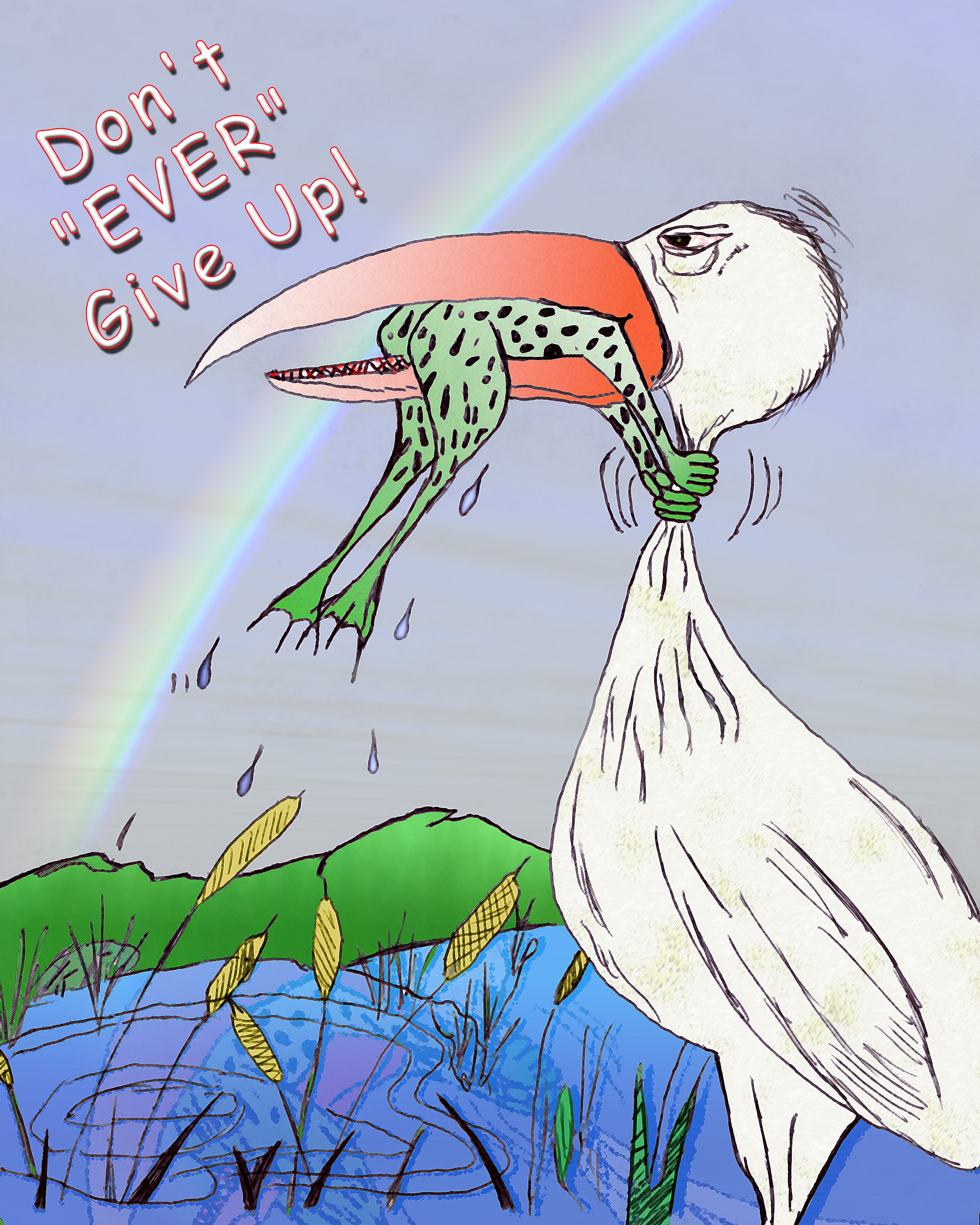
It’s frustrating. It’s angering. But even anger can be our friend. Like the drawing at the top of this blog says, don’t ever give up. And sometimes not giving up takes getting a little pissed off.

That’s that for now. Please see below for the final installment of the feature story I wrote for the Edmonton Journal on my stroke.

Tim


Part 4

Former journalist Tim Seefeldt tells the story of his amazing journey to relearn the basics 3 Rs

By Tim Seefeldt, Edmonton Journal

June 13, 2014

I got a handle on the alphabet with the help of flash cards designed for children. The cards would show me a b,d and aD and I’d try to parrot back what letters they stood for. Then it was on to flash cards with entire words on them. From there it was cards with questions.

I also had packs of children’s “First Words” cards. They’d have simple pictures with the corresponding name written beneath. So, a picture of a book would have the boldly coloured letters b-o-o-k beneath it. And who could forget the page after page of pictures of forks, pens and dogs? be-It turns out that I could. Initially it was tough to make the connections. But little by little, my brain seemed to kick back into gear and this stuff started to click.

I’d work through these with Heather at our sessions. Patricia would run through them with me several times a day every day. And I’d work on it the best I could by myself.

At times it was humiliating to be staring at worksheets designed for children and know that I was struggling to do would many kids could manage with ease.

Heather motivated me by getting me to write my story. When this started – about a month after my stroke – the writing was very rough. I couldn’t read it moments after I’d written it. But I felt like I was working on a real project, proving fate wrong.

As the weeks went by, the homework got more complex. By summer I’d moved on to exercises that required me to fill in missing words in short sentences. Was the right word hurry or worry? And then there were the “builds.” These would start with a couple of sentences that would build the story to a short paragraph then a longer one, exercising my reading ability and memory.

To spice things up, I had pages and pages of simple math sheets. Stuff like: You have three quarters and your pop cost you 54 cents. How much money do you have left? To be in my mid-40s and unable to easily make simple change was depressing. But I learned to cherish every simple improvement.

Heather picked up the pace. She added newspapers designed for new Canadians to my rehab. I’d practise reading and be tested on comprehension. Eventually, I started taking on sections from books and doing verbal story reports.

By August, things had improved enough to allow me to start working part time. I worked for a consulting company that used social science to solve problems. My job was to bring in clients and I had to solve the complex problem of how to succinctly explain to them what we did.

We identified a reading device I was able to load on my computer to help me read. Without this, a return to work would have been impossible.

An average person reads at between 150 and 190 words per minute. I was at 20 in the early days of rehab and improved to 51. I still use the reading device today.

As well as things were going, there were a few shots of ugly reality to come. In the fall I was going to face a comprehensive series of tests at the Glenrose Rehabilitation Hospital over the better part of a day. These were supposed to show how well my brain was rebooting. It would isolate specific regions to determine how they performed on their own.

The pace of my rehab continued to pick up. I joined a quirky reading group at the Glenrose geared to the strokedout and brain injured. At my first meeting, I met a guy in his early 50s who inspired me. His summaries were a bit wordy but I was impressed with his reading speed. If he could do this, so could I, right? During a coffee break I chatted with him.

“You’re doing great,” I said. “Thanks,” he said. “And it’s only been six years since I had my stroke.”

That was another shot to the gut. Would I still be here in six years? Would my parttime work fizzle and leave me unemployed and on financial assistance my remaining days? What would the test at the Glenrose tell me? Was I just fooling myself?

I failed the test. With the different parts of my brain tested in isolation, I couldn’t stand up to the pressure. But the neuropsychologist who oversaw the test told me a secret.

While parts of my brain in isolation may not be up to snuff, she said it appeared that I’d learned some tricks over the previous months that could override the deficits. Notetaking was a big help and something that came naturally from my journalism days. She said just the act of taking notes helped memory.

“Who knows how much you’ll be capable of?” she said. “Keep trying and don’t let this test define you.”

It’s been four years and I’ve spent every day trying to prove that test wrong. Most days I succeed.

Sure, the scars are still there. I’m reminded of them every time I punch in the wrong numbers on an ATM with a long frustrated line behind me.

On the surface, I live a pretty average life now. And to me that’s a huge sign of success.

I’m among more than 315,000 Canadians who are living with mild, moderate or severe disabilities due to stroke.

And what’s so frustrating to so many survivors: half of the people who have had strokes are never able to work again. This includes people in their 20s, 30s, 40s and 50s. I’ve seen this first-hand through volunteer work with the Stroke Recovery Association and its program with Alberta Health Services that sees stroke survivors visit new victims in hospitals.

I’m in a new job and for the most part folks wouldn’t notice I’m a stroke victim. Patricia and my girls treat me like a husband and dad. That is, they get angry at me or laugh with me, they don’t pity me and walk on eggshells around me. I even got my driver’s licence back.

Patricia also played the role of head coach and motivator while my daughters – Kristina and Anna – were my inspiration. This is more than a nice to have. Research shows that support from family and friends is a powerful tool in recovery.

So is amazing rehab. I had this in spades. Every stroke is different, so the job of rehabilitation is a real head game. It’s too complex for a cookie-cutter approach.

“The treatment plan is different for everybody,” said Heather Stamler, the Speech-Language Pathologist who led my rehabilitation. “It’s not like one mode of therapy fits everybody. We interpret what we discover and we go from there with the input of the patient.”

Stamler said they try to work with the patient’s goals top of mind.

“In your case you were young and you wanted to get back to work. You were eager and motivated,” she told me. “You were instrumental in working on a treatment plan with us. So we made it very specific to you getting back to the kind of work that you’d been doing.”

The wrinkle was that as somebody who relied heavily on reading and writing at work, the stroke hit me in about the worse place possible.

“It was going to be very difficult for you to get back to be doing those things,” said Stamler.

So she and her colleagues studied the kind of work I did, talked to me about the job and came up with a plan that would give me the best shot at getting back to it.

Beyond the practical role of rehabilitation, Stamler noted the importance of being aware of the emotional toll a stroke puts on the victim and the people in their lives. This needs to be dealt with compassionately as the treatment moves forward.

And as the stats above suggest sometimes the stroke victim’s goals won’t line up with reality.

“Success may not look exactly like it did pre-stroke,” she said. “Some people compare their new self to their old self. You can’t do that.”

That you’re reading this proves there’s at least the hope of a road back from stroke. I’ve tapped out a book as well, something that I couldn’t even manage before my brain was fried. Whether or not I ever get a publisher to bite on the book, the words are there in black and white.

Proof that you can put Humpty Dumpty back together again.